May 12, 2025 | 77 minutes, 22 seconds
Download
In this episode of the Ayurveda Meets Modern Science podcast, Dr. John answers your questions about the lymphatic system! We asked the LifeSpa community to submit their questions about lymph, and here, Dr. John answers as many as he can.
To find out if your lymph is congested, take our Lymph Quiz here!
In This Article
The Miracle of Lymph: Bridging Western Science and Ayurveda
The lymphatic system, often overshadowed by its circulatory counterpart, is a silent guardian of our health. In Ayurveda, this system is called rasa, the first of the seven bodily tissues (dhatus). The study of rasa (rasayana) is the science of longevity and rejuvenation. Modern science is now catching up, unveiling the lymphatic system’s pivotal roles in immunity, detoxification, and overall vitality.
The Lymphatic System has 3 primary roles:
- Carry the Immune System
- Detoxify the Body
- Deliver fats as Fuel to Every Cell For Energy
The Ayurvedic perspective on painful periods, water retention, and more considers lymph system congestion a primary culprit. Here, helpful suggestions for how to identify and deal with premenstrual and menopausal problems: Menopause and PMS Symptoms: They May Not be Hormonal
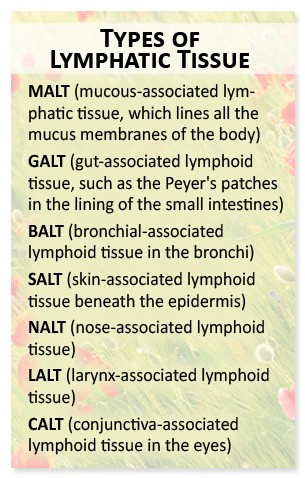
Types of Lymph Tissue
Brain Glymphatics: The Brain’s Cleansing Mechanism
Recent discoveries have highlighted the glymphatic system—a network that clears waste from the brain during deep sleep. This system removes neurotoxins, including amyloid-beta, which is associated with Alzheimer’s disease. Ayurveda offers tools like nasya (nasal administration of herbal oils) and pranayama (breathing exercises) to support this cleansing process.
See also How to Detox Your Brain + Cerebrospinal Fluid (CSF)
Gut Lymph: The Foundation of Immunity
The gut-associated lymphoid tissue (GALT) governs 70% of our immune system, called gut immunity. It also acts as a barrier and a communicator between the external environment and our internal systems. Ayurveda emphasizes the importance of a balanced gut for overall health, recommending seasonal diets and herbs to maintain digestive and lymphatic harmony.
See also Ayurvedic Treatments for Your Lymphatic System
Skin Lymph: The Interface with the External World
Our skin is not just a protective barrier; it’s an active immune organ. Skin-associated lymphoid tissue (SALT) plays a crucial role in detecting and responding to pathogens. Ayurvedic practices like abhyanga (oil massage) with lymphatic herbs such as manjistha can support skin health and lymphatic flow.
See also Self-Massage, Self-Love, + Self-Healing with Daily Ayurvedic Abhyanga
The Lymph-Nitric Oxide Connection
Research on Nitric Oxide won the Nobel Prize in 1998 as the “New Panacea Molecule”. Nitric Oxide is an antiviral, antibacterial gas that enhances vasodilation throughout the blood vessels in the body. It has been shown to support the treatment of Metabolic Syndrome, cardiovascular disease, Alzheimer’s, diabetes, and much more. Nitric oxide declines with age, which allows stress to more deeply impact normal function and normal aging of the body.
Nitric oxide (NO) plays several important and nuanced roles in the lymphatic system, influencing lymphatic vessel tone, permeability, immune cell trafficking, and lymph flow regulation. Here’s a breakdown of how NO impacts different aspects of the lymphatic system:
1. Lymphatic Vessel Tone and Contraction
- Smooth muscle relaxation: Like in blood vessels, NO causes relaxation of lymphatic smooth muscle, reducing vessel tone.
- Modulation of rhythmic contractions: Lymphatic vessels (especially collecting lymphatics) contract rhythmically to propel lymph.
2. Lymph Flow Regulation
- Endothelial nitric oxide synthase (eNOS=increases nitric oxide) in lymphatic endothelium responds to increased lymph flow or stretch by producing NO, which then modulates vessel tone to maintain flow.
- Backflow prevention: By regulating valve function and vessel relaxation, NO helps maintain unidirectional lymph flow.
3. Lymphatic Permeability
- Barrier function regulation: NO increases the permeability of lymphatic endothelial cells, which increases the entry of immune cells into the lymph.
4. Immune Cell Trafficking
- NO influences immune cell activation and migration through the lymphatics.
5. Inflammation and Immune Regulation
- Dual role in inflammation: At physiological levels, NO has anti-inflammatory effects, promoting homeostasis.
Top Foods That Boost Nitric Oxide & Support Lymphatic Function
- Beets (and beet greens)
- Rich in dietary nitrates, which convert to NO in the body.
- Beet greens also contain fiber and antioxidants that aid in lymph flow.
- Check out Dr. John’s Apple, Beet, Celery (ABC) Juice recipe
- Learn more about Dr. John’s Beet Cleanse formula
- Arugula, spinach, and leafy greens
- Among the highest in nitrates for NO production.
- High in chlorophyll and magnesium, which support detox and lymphatic flow.
- Garlic and onions
- Boost eNOS activity to promote NO synthesis.
- Contain sulfur compounds that enhance detoxification and lymph drainage.
- Citrus fruits (lemons, oranges, grapefruits)
- High in vitamin C, which stabilizes NO and supports lymphatic vessel integrity.
- Aids in lymph movement by promoting hydration and tissue repair.
- Read about the Benefits of Eating Your Citrus Peels
- Learn more about LifeSpa’s Lymph-Vein HP formula with citrus-based flavonoids
- Watermelon
- Rich in L-citrulline, an amino acid that increases NO via the arginine pathway.
- Provides hydration, which is critical for lymph flow.
- Pomegranate
- Boosts eNOS expression and protects NO from oxidative damage.
- Also supports lymphatic detoxification via polyphenols.
- Celery and parsley
- Contains apigenin and other flavonoids that enhance NO and reduce inflammation.
- Mild diuretic effects promote lymphatic drainage.
- Berries (blueberries, strawberries, raspberries)
- High in antioxidants that protect NO and reduce lymphatic inflammation.
- Support capillary health, improving lymph absorption.
- Nuts and seeds (especially walnuts, flax, and chia)
- Rich in arginine and omega-3s, which support NO production and reduce lymphatic congestion.
- Fermented foods (e.g. sauerkraut, kimchi, yogurt)
- Improve gut-liver-lymphatic axis, supporting systemic detox.
- Indirectly enhance NO via gut microbiota balance.
6-Step Lymph Detox Plan
In Ayurveda, rasa refers to the nutrient fluid that nourishes all tissues, and rasayana therapies aim to enhance this essence. Herbs like manjistha and brahmi are considered potent rasayanas, supporting lymphatic function and overall vitality.
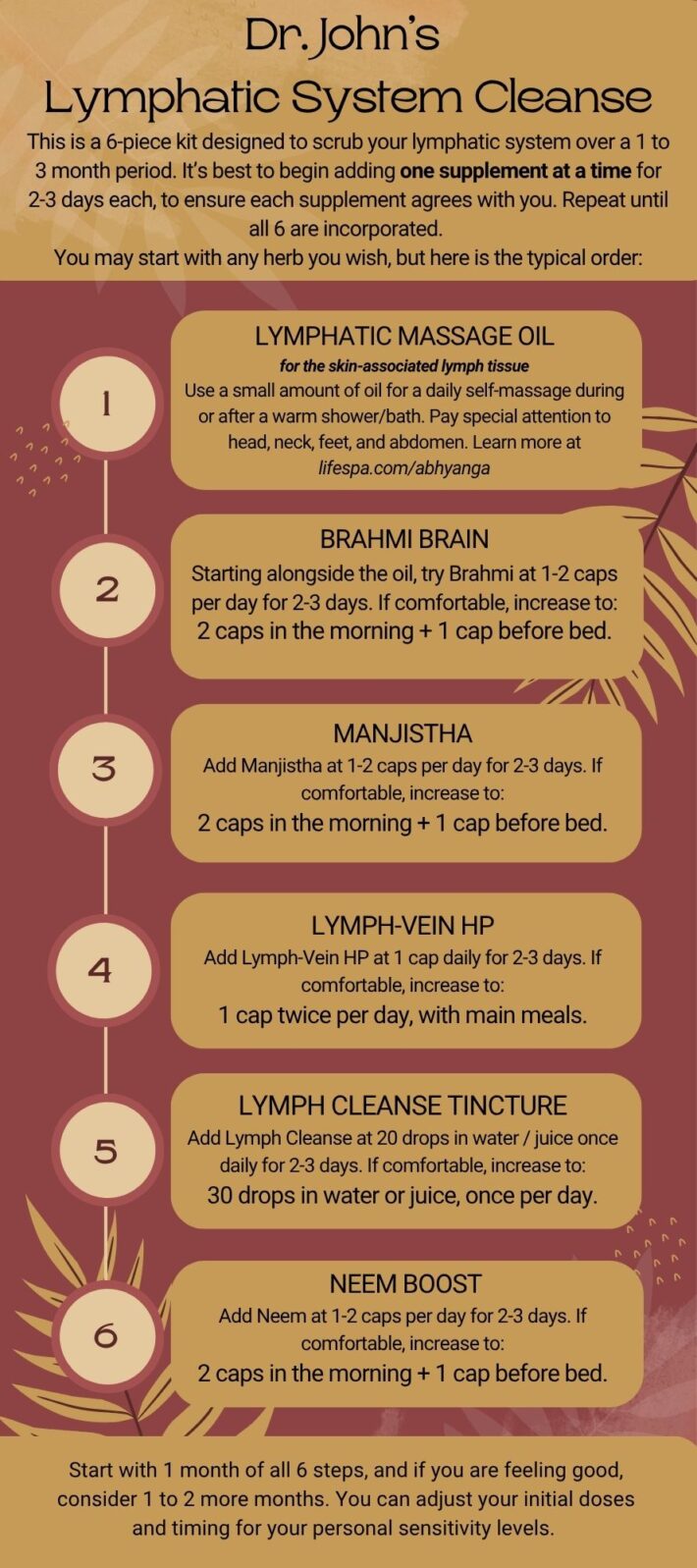
While the Colorado Ayurvedic Cleanse and the Short Home Cleanse are powerful lymph-cleansing detox programs, I created this more focused lymph detox in support of lasting benefits.
Note: The lymphatic system drains the body during the day with physical movements, such as exercise, and the subtle brain and central nervous system lymph channels drain at night, during sleep. Thus, I suggest taking some of the lymph support before bed and first thing in the morning. Exercise and hydration are also key during any lymph cleanse period.
Step 1: Lymphatic Massage Oil – to calm the nervous system and support lymph movement
Lymphatic Massage Oil is rich with lymphatic herbs, like manjistha, that support healthy lymph flow in the skin-associated lymphatic tissue. Oil massage also feeds the natural bacteria on the surface of the skin, while calming the vata or sensory nerve endings on the skin itself.
Step 1 Directions: Massage daily with a small amount of oil during a warm shower or bath, give special attention to areas of lymphatic concentration: the head, neck, feet, and abdomen. For external use only.
Learn more about Lymphatic Massage Oil
Step 2: Brahmi Brain – to support the brain and intestines
Brahmi (Centella asiatica) is Ayurveda’s premier herb for brain function and mental clarity. Recently, studies have found that brahmi (not to be confused with bacopa) supports the health of the skin both on the inside of the intestinal tract as well as the outer skin of the body. Numerous brahmi antioxidant constituents have been found to support micro-circulation and lymph flow as well. With the new research on lymphatic vessels that drain the brain and central nervous system during sleep, brahmi may be the most effective herb for supporting brain health, cognitive function, and brain lymph drainage.
Step 2 Directions: Take 2 capsules in the AM and 1 before bed.
Learn more about Brahmi
Step 3: Manjistha – to support the lymphatic system and liver.
Manjistha (Rubia cordifolia) is a red root that has been traditionally used to decongest the lymphatic system and liver. It is loaded with antioxidants that boost the body’s production of glutathione and other liver-shielding agents. The lymphatic system is the body’s major detox system and, when exposed to toxins, constituents of manjistha helped reduce lipid peroxidation damage and boost antioxidants, such as glutathione, superoxide dismutase, and catalase.
Step 3 Directions: Take 2 capsules in the AM and 1 before bed.
Learn more about Manjistha
Step 4: Lymph-Vein HP – to support micro-circulation
Citrus pith has been used in Ayurveda to support the circulatory function of the body. New studies have found that diosmin, an active ingredient in the white pith (rind) of oranges, has been shown to effectively support healthy microcirculation by increasing lymphatic contractions. Lymphatic congestion is linked to water retention, bloat, cellulite, sluggish immunity and much more. LifeSpa’s Lymph-Vein HP contains diosmin from the white pith of citrus as a powerful lymphatic decongestive agent.
Step 4 Directions: Take 1 capsule twice per day with food.
Learn more about Lymph-Vein HP
Step 5: Lymph Cleanse Tincture – to boost lymph-scrubbing and lymph flow
Lymph Cleanse is a tincture that combines a host of lymph-cleansing herbs such as Red Root, Ocotillo, Stillingia, Astragalus, and Ginger, and is formulated to scrub both the lymphatic system all over the body and the lining of the intestinal tract, where the majority of the body’s lymphatic system originates.
Step 5 Directions: Take 30 drops in water or juice once a day on an empty stomach. Taking it with food may be a bit easier on the stomach.
Note: For more aggressive results, this can be taken up to 3x/day.
Learn more about Lymph Cleanse
Step 6: Neem Boost – to support the skin and microbiome
Neem (Azadirachta indica) is Ayurveda’s classic herb for the health of the body’s inner and outer skin. It naturally scrubs the intestines of bad, undesirable microbes while supporting the growth of beneficial bacteria. The health of the microbes in the intestines depends on the health of the inner skin and the intestinal lymph drainage. With over 140 compounds, neem supports the health and function of the microbiology, intestinal skin and the function of the lymph flow that drains the intestinal tract.
Step 6 Directions: Take 2 capsules in the AM and 1 before bed.
Learn more about Neem Boost