In This Article
Lithium Citrate vs Lithium Orotate
Update August 2025:
A groundbreaking Harvard Medical School study, published in Nature this month, has sparked worldwide attention on a little-known fact: tiny amounts of the mineral lithium may help protect the brain from Alzheimer’s disease.
Researchers found that lithium naturally occurs in the brain, and that people in the early stages of Alzheimer’s had significantly lower levels of this mineral. Even more remarkable, when researchers gave mice with Alzheimer’s-like brain changes low-dose lithium orotate—the same safe, nutritional form found in certain supplements—the animals recovered lost memory and showed healthier brain tissue.
This is big news, but it’s not entirely new. Here at LifeSpa, we’ve been exploring the Ayurvedic and modern scientific aspects of lithium’s role in mood, cognitive function, and longevity for years. In fact, this very article below, which I first published in 2020, outlined how dietary lithium from food and trace-mineral supplements could support emotional balance and brain health—long before this new research hit the headlines.
In the sections below, you’ll learn:
• Which foods naturally contain lithium
• How lithium supports healthy mood and cognitive function
• The difference between nutritional lithium orotate and prescription lithium carbonate
• How Ayurvedic wisdom aligns with this modern discovery
With Alzheimer’s now affecting more than 6 million Americans, and no definitive cure in sight, the science is pointing us back to something surprisingly ancient: a trace mineral found in water, soil, and plants—and in the Ayurvedic tradition, a deep understanding that brain health starts with nourishing the whole body.
Original article from 2020:
Did you know that the mood-enhancing benefits of lithium were the “up” in the original 7-Up? It was “7-Up Lithiated Lemon Soda” until 1936, when it was renamed just “7-Up,” still with its 7 ingredients—one of which was lithium.1
In the 1800s, a natural lithium spring outside of Atlanta attracted presidents and celebrities like Mark Twain and the Vanderbilts, all convinced of the healing lithium waters, called sweet water by Native Americans.
Today, most people think of lithium as a pharmaceutical drug for bipolar states of mania and depression, and it has been the go-to drug for this since 1949. As a drug, high dosages of the potentially toxic form, lithium citrate, are used, but studies suggest lithium as much lower dosages of the nontoxic form, lithium orotate, plays a key role in supporting mood stability, longevity, and cognitive health.2
Benefits of Lithium Orotate
A number of observational studies have found that in areas where there is a higher amount of lithium in the drinking water, there was a significant decrease in suicides.2 The effect of consuming trace levels of lithium in the diet have been so well-studied for mood, longevity, and cognitive function that many leaders in the field of psychiatry are advocating for certain foods to be enriched with lithium in the same way salt was iodized in the 1920s.2
Studies also link optimal lithium levels to healthy heart function, optimal blood sugar levels, and higher energy levels, along with increasing vitamin transport.2 Lithium has also been shown to increase concentration of the grey matter (cortex) of the brain, while increasing size of the amygdala (emotional cortex) and hippocampus. It has also been shown to stimulate natural production of neural stem cells and to have protective anti-oxidative effects for the nervous system.2 Lithium stimulates activity of mood-supportive agents, such as glutamate, dopamine, serotonin, gamma-aminobutyric acid, acetylcholine, and glycine.2
In a Japanese study where all-cause mortality was evaluated, they measured the lithium content in the drinking water of over 1.2 million people in 18 neighborhoods. The ones drinking from the highest lithium water sources saw a significant reduction in all-cause mortality compared to those where the water had less lithium.3 Lithium was also shown in animal studies to extend the lives of roundworms, yeast, and fruit flies as much as 46%.4,5,6
Microdose with Lithium
In another study on humans, a daily microdose of just 300mcg of lithium was shown to significantly reduce age-related cognitive decline just three months after starting to take a lithium supplement.7 Lithium has been shown to inhibit an enzyme called glycogen synthase kinase (GSK-3). Without sufficient lithium, the cells struggle to protect themselves from excess GSK-3 and the ravages of aging, as well as a host of age-related health concerns.2,5,7

Studies also suggest that lithium depends on the availability of other minerals and works synergistically with other minerals to maximize its effectiveness for mood, longevity, and cognitive support.2 Mineral deficiencies pose a serious threat to our health, as they are responsible for thousands of biochemical processes. Soils have been demineralized with modern chemical farming techniques and farmers struggle to healthfully reintroduce missing minerals back into their soils—but commonly in forms difficult for us to absorb.10
Mineral Deficiencies
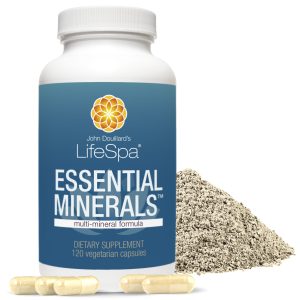
It is estimated that up to two-thirds of the world’s population might be at risk for deficiency in one or more essential mineral elements. According to the Copenhagen Consensus 2008, mineral deficiencies are one of the most serious challenges to humankind.9
Albion Laboratories, the world’s leader in patents on supplemental minerals, and the source of LifeSpa’s Essential Minerals (with lithium) published a conservative estimate of mineral deficiencies in the United States:8
- Magnesium: 75%
- Iron: 58%
- Copper: 81%
- Manganese: 50%
- Chromium: 50%
- Zinc: 67%
Getting Lithium and Minerals from Your Food
94% of Americans don’t eat enough fruits and vegetables to get an adequate amount of minerals in their diet, and even when we do, our soils are so depleted that even organic foods are lacking in mineral content.8
Many studies now emphasize the importance of taking environmental doses of lithium. It is found in certain foods and many water supplies, but the amount of lithium available in one’s diet depends on the soil where your food is grown and the source of your drinking water.
Main Sources of Dietary Lithium

- Cereals
- Potatoes
- Tomatoes
- Cabbage
- Some mineral waters
- Nutmeg
- Coriander seeds
- Cumin
- Black tea
- Green tea
- Red (rooibos) tea
Keep in mind, all of this depends on the soil and geography. It is estimated that cereal grains and vegetables cover from 66 to over 90% of the daily lithium consumed. The rest comes from food of animal origin and drinking water.
One study predicted that a vegetarian diet, high in grains, legumes, and vegetables will provide more lithium than a diet that includes intake of animal proteins, but once again this all depends on the soil.2
Lithium Conclusion

It is a challenge to know exactly how much lithium you are getting from your food and water. The low-dose range for optimal lithium supplementation is 250mcg-1000mcg. LifeSpa’s Essential Minerals has 250mcg of lithium orotate per two capsules, plus it provides industry-leading absorption rates of all the other minerals needed to offset potential deficiencies.
Essential Minerals Dosage: Four caps a day for one month. Two caps per day thereafter to maintain optimal levels of essential minerals and lithium.
See also Are Multiminerals the New Multivitamins?